
SKI RACING HELMETS
FIT. PROTECTION. TECHNOLOGY. RESPONSIBILITY.
A properly fitted helmet is one of the most important pieces of safety equipment your young ski racer will wear.
But wearing a helmet and wearing one correctly are two different things.
Every season, I see SRT athletes wearing helmets that are too loose, positioned incorrectly, or secured with improperly adjusted chin straps.
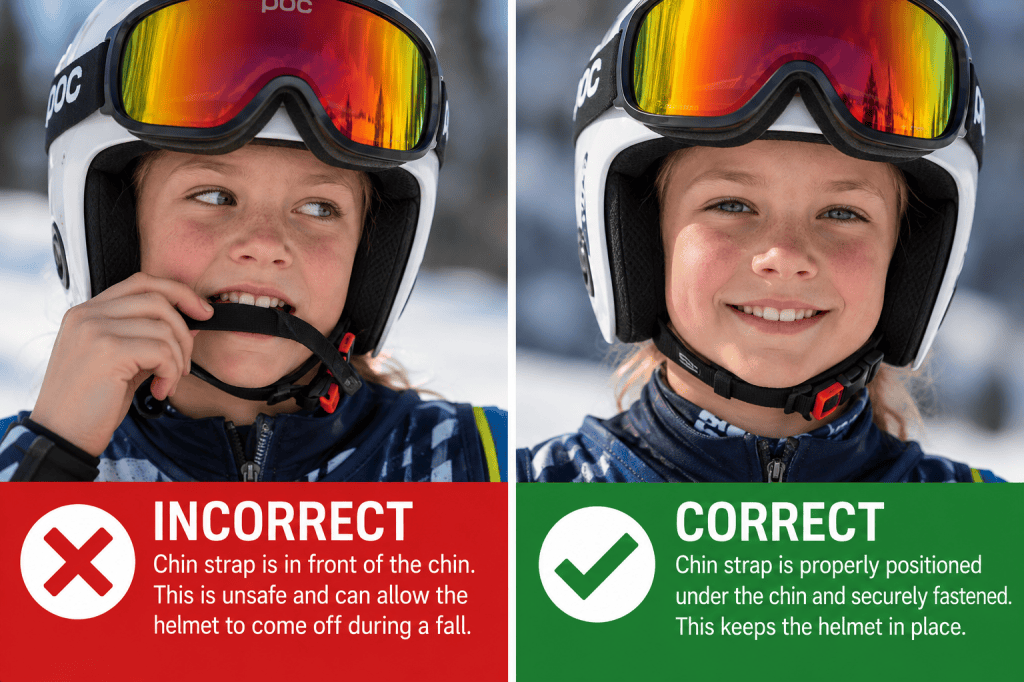
One of the most common problems is a chin strap that hangs loosely or rests in front of the chin rather than securely underneath it.
A helmet that moves out of position or comes off during a crash cannot provide the protection it was designed to deliver.
The purpose of this guide is to help SRT parents and guardians understand proper helmet fit, current safety technologies, helmet certifications, and the limitations of protective equipment.
Our goal is straightforward: help every racer arrive at training and competition with a helmet that fits correctly and is appropriate for alpine ski racing.
— Coach Mya
1 | HELMET FIT COMES FIRST
THE MOST IMPORTANT INFORMATION ON THIS PAGE
The best helmet is not necessarily the most expensive helmet. It is a properly certified helmet that fits your child’s head correctly and stays securely in place.
Before evaluating advanced materials, rotational-impact technologies, or premium racing designs, start with the fundamentals.
Helmet Position
A properly positioned helmet should:
- Sit level on the head, covering the forehead without obstructing normal vision.
- Fit snugly around the entire head without uncomfortable pressure points.
- Remain stable when the wearer moves their head.
- Resist excessive forward, backward, or side-to-side movement.
- Accommodate goggles without creating a significant gap or pushing the helmet out of position.
A helmet that rocks excessively or slides over the forehead may be too large or incorrectly adjusted.
The Chin Strap
This is the fitting issue I most frequently see among young racers.
The chin strap should pass securely underneath the chin—not in front of it.
When properly adjusted:
- The buckle is fully fastened.
- The strap rests beneath the chin.
- Excessive slack is removed.
- The helmet cannot easily roll forward or backward off the head.
- The strap remains comfortable enough for the athlete to wear throughout training.
A useful initial check is that approximately one or two fingers fit between the strap and chin, but the helmet manufacturer’s instructions take priority.
A loose chin strap can allow a helmet to shift or come off during a fall or collision.
Face Coverings and Neck Gaiters
Neck gaiters, balaclavas, and other cold-weather accessories should not interfere with helmet fit or chin-strap security.
Avoid bulky material between the chin strap and the chin.
Thin helmet-compatible liners may be appropriate when permitted by the manufacturer, provided they do not change the helmet’s fit.
The Parent Fit Test
Before the first training session of the season:
- Have your child put on their helmet and fasten the chin strap.
- Check the helmet’s position on the forehead.
- Gently attempt to move the helmet forward, backward, and sideways.
- Confirm that the helmet moves with the head rather than sliding independently.
- Check the fit with the athlete’s racing goggles.
- Ask your child whether the helmet creates pressure points or discomfort.
Repeat these checks periodically throughout the season.
Children grow. Helmet padding compresses. Adjustment systems loosen. A helmet that fit last winter may not fit correctly today.
2 | SKI RACING HELMETS ARE NOT ALL THE SAME
CHOOSE EQUIPMENT FOR THE EVENT
Alpine ski racing places different demands on protective equipment depending on the discipline.
Giant Slalom
Giant Slalom involves relatively high speeds, sustained turns, and contact with race gates.
A hard-sided alpine racing helmet with appropriate ear coverage is generally the preferred design.
SRT families should verify the current WIJARA helmet requirements before purchasing equipment.
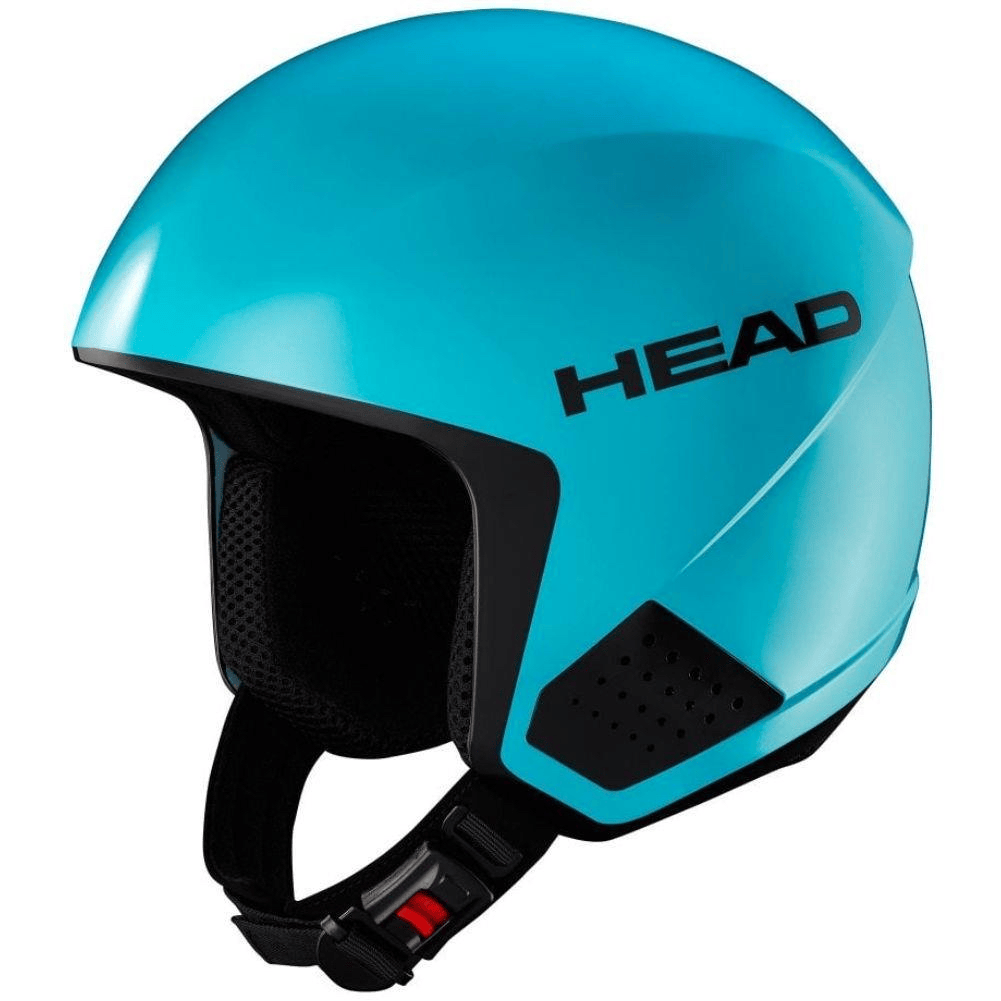
ABOVE: Full Hardsided Helmet Approved For Giant Slalom
Slalom
Slalom involves repeated contact with closely spaced gates.
Racers may use helmets with removable chin guards designed specifically for slalom.
A chin guard should only be used when approved by the helmet manufacturer and permitted under the applicable competition rules.
Never attach an improvised guard or modify a helmet.
One Helmet or Two?
Many junior racers use one suitable racing helmet for both Slalom and Giant Slalom.
That can be a practical choice, provided the helmet meets the applicable requirements for both events and any chin guard is manufacturer-approved.
Families do not necessarily need to purchase multiple helmets.
Correct fit, appropriate certification, and event compatibility matter more than owning the most expensive equipment.
3 | UNDERSTANDING MODERN HELMET TECHNOLOGY
BETTER ENGINEERING. MORE OPTIONS. IMPORTANT LIMITATIONS.
Modern helmets incorporate advances in materials, impact-management systems, ventilation, and fit adjustment.
Two technologies families frequently encounter are Mips and BOA.
They address different problems.
MIPS | ROTATIONAL-IMPACT MANAGEMENT
Many helmet impacts occur at an angle rather than directly perpendicular to the head.
These impacts can produce rotational motion of the head, which is one factor associated with brain injury.
Mips is a technology designed to help manage rotational motion during certain angled impacts.
Some Mips-equipped helmets use a low-friction layer that permits limited relative movement within the helmet during an impact.
Other Mips designs integrate rotational-management features differently.
Why Does Rotational Motion Matter?
The brain is soft tissue surrounded by fluid and protected by the skull.
During a crash, rapid acceleration, deceleration, or rotation of the head can deform brain tissue and contribute to concussion or other traumatic brain injuries.
Concussions are not simply caused by the brain striking the inside of the skull.
Rotational acceleration is one of several important biomechanical factors researchers investigate when studying head injuries.
Does Mips Prevent Concussions?
No helmet technology can guarantee concussion prevention.
Laboratory testing indicates that some rotational-impact management systems can reduce certain measured rotational-motion indicators under specified impact conditions.
However, results vary among helmet designs, and laboratory improvements do not establish that a particular helmet will prevent concussion in an actual skiing accident.
Mips is a feature worth considering when purchasing a helmet, but it should not be treated as a substitute for correct fit, appropriate certification, or responsible skiing.
BOA | PRECISION FIT ADJUSTMENT
BOA is a fit-adjustment system found in some ski helmets and other sporting equipment.
Depending on the helmet design, a dial-operated mechanism allows the wearer to adjust the fit around portions of the head.
Why Can This Be Useful?
A well-designed adjustment system may help:
- Fine-tune helmet fit.
- Reduce unwanted movement.
- Accommodate small differences in head shape.
- Make adjustments easier while wearing gloves.
However, adjustment systems have limits.
A BOA-equipped helmet that is fundamentally too large is still the wrong helmet.
Fit systems should fine-tune an appropriately sized helmet—not compensate for buying one several sizes too big.
Not every helmet uses BOA. Other manufacturers offer their own adjustment technologies.
The name of the adjustment system matters less than how well the helmet fits the athlete.
4 | HELMET CERTIFICATIONS
WHAT SHOULD PARENTS LOOK FOR?
Helmet certifications indicate that a helmet model has been evaluated against specified performance requirements.
They do not guarantee that a helmet will prevent injury.
Common standards and racing-related markings include:
ASTM F2040
A widely recognized U.S. standard for helmets used in recreational snow sports.
It includes specified impact-performance and other requirements.
EN 1077
A European standard for alpine skiing and snowboarding helmets.
It includes different helmet classes with distinct coverage and performance requirements.
FIS RH 2013
A racing helmet specification associated with certain FIS alpine competition requirements.
Helmets intended for events requiring this specification must meet the applicable requirements and display the required conformity marking.
Which Certification Does My Child Need?
The answer depends on the competition, discipline, and governing organization’s current rules.
WIJARA requirements may differ from those applicable to U.S. Ski & Snowboard or FIS-sanctioned competitions.
Families should not assume that a helmet approved for recreational skiing automatically satisfies every racing requirement.
Likewise, a helmet marketed as a racing helmet is not necessarily approved for every event.
Before purchasing, verify:
- The helmet’s actual certification markings.
- Whether it is suitable for Slalom and Giant Slalom.
- The applicable WIJARA requirements.
- Any additional rules for races outside WIJARA.
- Whether accessories such as chin guards are approved.
SRT recommends selecting a properly fitted, certified alpine racing helmet appropriate for the athlete’s events.
For families considering higher-level competition, checking FIS-related requirements before purchasing may help avoid needing another helmet later.
5 | WHEN SHOULD A HELMET BE REPLACED?
HELMETS ARE PROTECTIVE EQUIPMENT, NOT PERMANENT EQUIPMENT.
A helmet’s condition matters as much as its original design.
Replace or Retire a Helmet When:
- It has sustained a significant impact.
- The manufacturer recommends replacement following a crash.
- The shell is cracked or visibly damaged.
- The internal protective liner is damaged or compressed.
- The retention system or buckle is damaged.
- The helmet no longer fits correctly.
- It has reached the manufacturer’s recommended service life.
Some impact-related damage may not be visible.
After a significant crash, do not assume a helmet is safe simply because its outer shell looks intact.
Consult the manufacturer and replace the helmet when indicated.
What About Used Helmets?
Exercise caution when purchasing secondhand helmets.
If the helmet’s impact history, age, or storage conditions cannot be verified, its protective condition may be uncertain.
For junior racers, a new helmet from a reputable manufacturer is generally the safer purchasing choice.
6 | THE LIMITATIONS OF HELMET PROTECTION
A HELMET REDUCES RISK. IT DOES NOT ELIMINATE RISK.
This distinction is important.
Helmets are designed to manage certain impact forces and may reduce the likelihood or severity of some head injuries.
However, skiing and ski racing involve conditions that can exceed the protective capabilities of any helmet.
These include:
- High-speed collisions.
- Impacts with trees, lift towers, or other fixed objects.
- Collisions with other skiers.
- Falls on hard or icy surfaces.
- Multiple impacts during a single accident.
- Severe rotational or linear acceleration of the head.
Even a properly fitted, certified helmet cannot guarantee protection from concussion, skull fracture, serious brain injury, or death.
A helmet is one part of a larger safety system.
That system also includes sound judgment, appropriate speed, equipment maintenance, coaching, situational awareness, and adherence to established skiing rules.
Helmet Use and Concussion Awareness
Any athlete suspected of sustaining a concussion should stop skiing immediately and be evaluated by an appropriate healthcare professional.
A racer should not return to skiing or training on the same day when a concussion is suspected.
Return to sport should follow applicable medical guidance and clearance requirements.
Parents and athletes should review SRT’s Concussion Awareness and Safety Policy before the season.
7 | THE SRT HELMET SAFETY CHECK
FIVE THINGS TO CHECK BEFORE EVERY TRAINING SESSION
1. FIT
Does the helmet sit securely and comfortably on the athlete’s head?
2. CHIN STRAP
Is the strap buckled and adjusted securely underneath the chin?
3. POSITION
Does the helmet remain properly positioned when the athlete moves their head?
4. CONDITION
Are the shell, liner, buckle, and retention system free from visible damage?
5. EVENT APPROPRIATENESS
Is the helmet appropriate for the training activity or competition?
These checks take very little time.
They should become part of every racer’s normal preparation routine.
8 | A FINAL WORD TO SRT FAMILIES
THE RIGHT EQUIPMENT. THE RIGHT HABITS.
As coaches, we spend considerable time teaching athletes how to ski more effectively.
We also want them to develop the judgment and habits that allow them to enjoy skiing throughout their lives.
Helmet safety is part of that education.
The technology continues to improve. Manufacturers are developing new materials, impact-management systems, and fit-adjustment designs.
Those developments are worth understanding.
But the fundamentals have not changed.
A helmet must fit.
The chin strap must be secured.
The equipment must be appropriate for the activity.
And every racer must understand that protective equipment has limitations.
Before the season begins, I encourage every SRT parent and guardian to take a few minutes to inspect their child’s helmet.
If you are uncertain about its fit, condition, or suitability for racing, ask an SRT coach or consult a qualified ski-equipment professional.
We would much rather answer a helmet question before training than discover a problem after a crash.
DEVELOPING ATHLETES. BUILDING CONFIDENCE. INSPIRING A LIFETIME OF SKIING.
— Coach Mya
Sundown Race Team

